How We Used $60,000 of Home Equity to Invest in ETFs and Scored a 20% Return

Mukul & Priyanka
Founders, WealthyWithTwo
Why We Turned Our Home Equity Into an Investment Portfolio
Buying a home in Australia is a massive milestone, but for many of us it is just the first step in a larger wealth-building journey. Once the excitement of moving in settles, you quickly realize that your hard-earned cash is locked up in bricks and mortar.
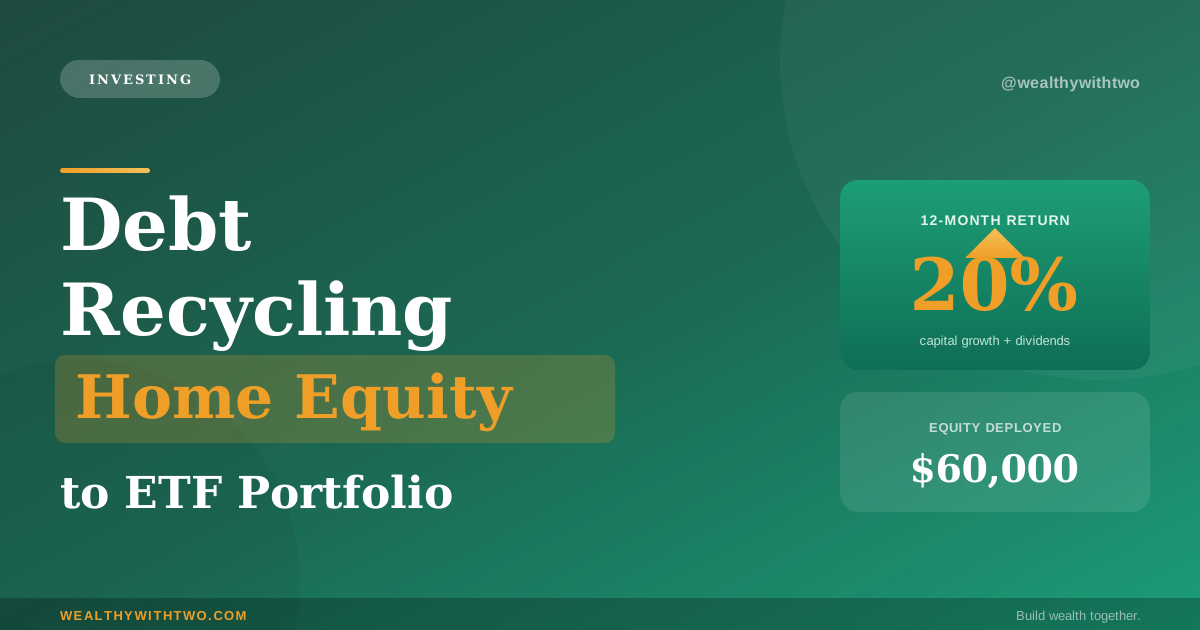
We bought our property in June 2024. Fast forward to March 2025, and thanks to a combination of market movements and regular repayments, we found ourselves sitting on $60,000 in usable home equity.
Instead of letting that equity sit idle, we decided to put it to work. We withdrew the funds and invested them directly into the stock market. One year later, that decision has yielded a 20% return.
We also made a video breaking down this entire strategy. You can watch it below or on our YouTube Channel.
Here is exactly how we did it, the ETFs we chose, the tax strategy we used, and the brutal realities you need to consider before trying this yourself.
Our Debt Recycling Strategy: One Equity Pool, Two Portfolios
We decided to split the $60,000 evenly: $30,000 for Mukul and $30,000 for Priyanka.
The ultimate goal was the same for both of us: long-term wealth creation through broad-market Exchange Traded Funds (ETFs). However, we wanted to experiment with different asset allocations. We knew there would be some underlying company overlap (tech giants appear in multiple global funds, for example), but building separate portfolios allowed us to test different geographic and yield-focused strategies.
Here is how our portfolios looked:
| Investor | Top ETF Holdings | Investment Focus |
|---|---|---|
| Priyanka | NDQ (Nasdaq 100), VHY (Aussie High Yield), ESTX (Euro Stoxx 50), VGE (Emerging Markets) | A mix of aggressive US tech growth, high-yield Australian dividends, and broad international diversification. |
| Mukul | IVV (S&P 500), VAS (Aussie Broad Market), VAE (Asia ex-Japan), VEQ (Vanguard Europe) | A classic powerhouse foundation centered on the US and Australian core markets, balanced with targeted Asian and European exposure. |
By spreading our investments across the US, Australia, Europe, and emerging markets, we ensured that our borrowed capital was not tied to the fate of a single economy.
Investing in the Red: Buying the Tariff Dip
Timing the market is generally a fool's game, but our entry point in March 2025 tested our nerves. We invested our money right when global exchanges were bleeding out due to anxieties surrounding US trade tariffs.
Seeing a portfolio drop in value immediately after investing borrowed money is enough to give anyone heartburn. In the short run, our balances dipped.
However, we stuck to a core investing truth: markets go up in the long run.
Instead of panicking, we viewed the tariff-induced downturn as a discount. Buying high-quality ETFs while the market was in the red meant we captured more units at a lower price, setting us up perfectly for the eventual rebound.
The Tax Advantage: How Loan Splitting Makes the Interest Deductible
You cannot talk about investing borrowed funds in Australia without talking about the Australian Taxation Office (ATO).
We did not just pull $60,000 out of our everyday redraw account and hope for the best. To do this cleanly, we set up a separate loan account (a split loan) with our bank.
Why a Split Loan Is Non-Negotiable
- Clean Audit Trail: By keeping the $60,000 completely separate from our primary home loan, there is zero commingling of funds.
- Easy Tax Deductions: Because the borrowed funds were used exclusively to buy income-producing assets (ETFs that pay dividends), the interest paid on this specific portion of the loan is generally tax-deductible.
- Simpler Tax Time: At the end of the financial year, we do not have to manually calculate what percentage of our interest belonged to the investment. The bank statement for that specific split gives us the exact number to hand over to our accountant to help reduce our taxable income.
TipTalk to your bank early. Not every lender makes loan splitting straightforward. Some charge a fee, and others require you to apply for a formal loan variation. Get this sorted before you transfer any funds so the ATO has a clean paper trail from day one.
The Results After 12 Months
Our long-term mindset paid off much faster than anticipated. Over the course of twelve months, the market shook off the tariff anxieties and went on a powerful bull run.
Between capital growth and dividends, our combined portfolios achieved a 20% return in one year.
On paper, it looks like a slam dunk. But it is vital to look at the full picture.
A Reality Check: Read This Before You Try Debt Recycling
While a 20% return sounds incredible, pulling equity out of your home is not free money. It is a high-risk strategy often referred to as debt recycling or leveraged investing.
Before you consider doing this, keep these realities in mind:
- You Have to Service the Extra Loan: Even if the stock market crashes, the bank still expects you to pay the interest on that extra $60,000 loan split every single month. You must have the cash flow to cover these payments comfortably out of your own pocket.
- Interest Rate Risks: If interest rates rise, the cost of servicing your investment debt increases. Your portfolio's yield and growth need to outperform your loan's interest rate (after tax benefits) for the math to truly work in your favor over time.
- Volatility is Guaranteed: We were comfortable watching our portfolio drop in the short term. If seeing your borrowed $60,000 shrink to $52,000 in a market downturn will keep you awake at night, this strategy is not for you.
- Past Returns Do Not Guarantee Future Results: We got lucky with timing. A 20% year is not normal, and you should plan for average long-term returns of 7-10% when running your numbers.
CautionDebt recycling amplifies both gains and losses. If the market drops 20% instead of rising 20%, you still owe the bank every cent of that $60,000 plus interest. Only pursue this strategy if you can absorb a worst-case scenario without it affecting your ability to pay your mortgage.
Final Thoughts
Withdrawing home equity to buy ETFs has been a powerful accelerant for our net worth, but it requires a stomach for volatility, strict bank account organization, and a long-term horizon.
If you are thinking about unlocking your home equity to invest, please do yourself a favor: be careful and speak to a qualified financial advisor. Every financial situation is unique, and you want to ensure your cash flow can handle the heavy lifting before you make the leap.
Disclaimer: This blog post chronicles our personal investment journey and is for educational and entertainment purposes only. It does not constitute financial, tax, or investment advice. Always consult with a licensed professional before making major financial decisions.
Written by Mukul & Priyanka
We moved to Sydney as international students in 2019 and navigated the Australian financial system firsthand. Today, we share the exact strategies we used to build wealth, buy our first home, and achieve financial security as a migrant couple.
Read our full story →