Sweating Your Cash: How to Beat the Big 4 and Lock In High Savings Rates in Australia

Mukul & Priyanka
Founders, WealthyWithTwo
Australia’s economic landscape has transformed dramatically over the last few years. For households navigating variable home loans or searching for rental properties, the aggressive rate-hiking cycle driven by the Reserve Bank of Australia (RBA) has felt uncomfortably punitive. Inflationary pressures have forced the official cash rate upward, creating a direct pipeline to higher monthly mortgage commitments and skyrocketing rental premiums as landlords look to offset ballooning financing costs.
Yet, while borrowers are bearing the brunt of this macroeconomic shift, individuals holding substantial cash balances find themselves standing in front of a unique window of opportunity. If you are actively hoarding cash, specifically if you are building a capital runway for your first home deposit, this high-interest environment can be flipped entirely to your advantage. The catch? Your money is only working for you if you break free from institutional loyalty.
The Big 4 Premium: A Notorious Disconnect
Australia’s major banking ecosystem (Commonwealth Bank, Westpac, NAB, and ANZ) operates on a historically profitable asymmetry. When the RBA announces a cash rate increase, the Big 4 are notoriously immediate in passing that increase down to their home loan consumers. However, when it comes to passing those exact same yield increases to standard savings account holders, a distinct lag occurs.
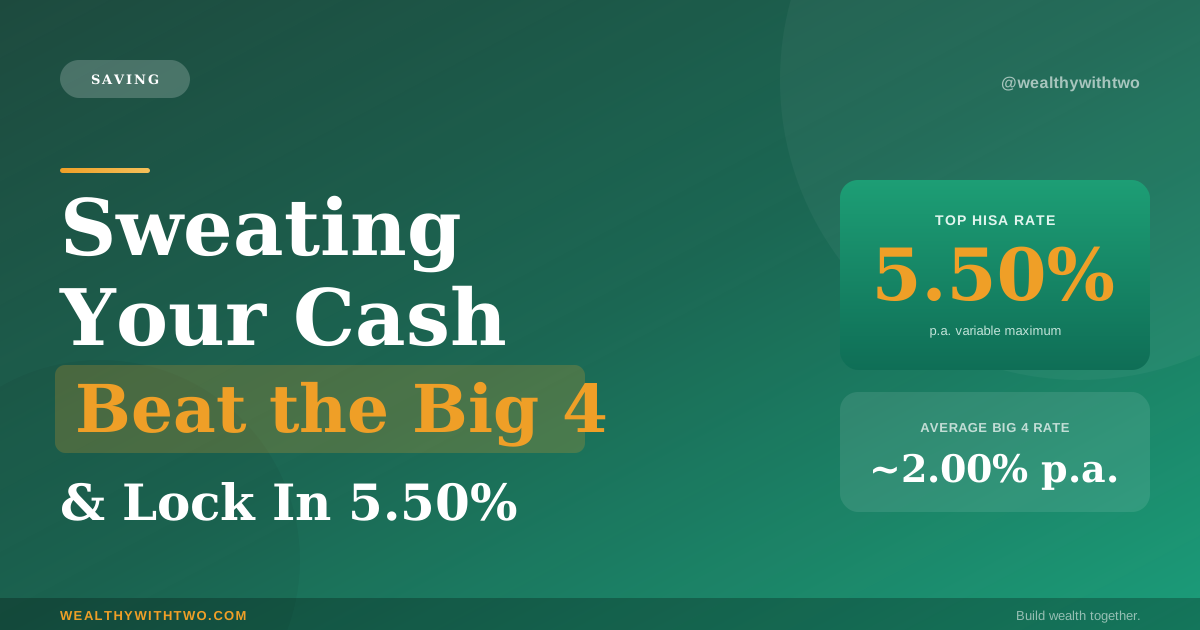
By leaving your hard-earned cash sitting in a baseline transaction or basic savings account at a primary bank, you are effectively paying a "loyalty tax." Standard variable savings rates frequently hover at a deeply uncompetitive 1.50% to 2.50% p.a. While some major banks offer flashy "introductory" promotional rates that jump above 5.00%, these are temporary marketing funnels. After a brief 4-to-5-month honeymoon window, your yield automatically cascades backward into a baseline rate that fails to keep pace with inflation.
Enter the Digital Challengers: uBank, Up, and ING
To combat this erosion of purchasing power, serious savers are shifting their attention toward smaller digital-first challengers and online-only institutions. Without the structural overhead costs of maintaining massive physical branch footprints and thousands of legacy administrative assets, these digital providers can structurally afford to pass higher ongoing yields directly back to consumers.
For individuals stacking a first home deposit, the mathematical spread between a legacy account and an online-only high-yield account represents thousands of dollars in free capital over a multi-year horizon.
High-Yield Retail Account Comparison (As of May 2026)
| Bank & Account Type | Maximum Variable Rate (p.a.) | Conditions Required | Balance Limit |
|---|---|---|---|
| ING (Savings Maximiser) |
5.50% | Deposit $1,000+ monthly from a non-ING account, make 5+ settled card purchases monthly, and grow your balance. | Up to $100,000 |
| Up Bank (Savers) |
5.35% | Make 5+ settled card/wallet purchases each calendar month to unlock the bonus rate. | Up to $250,000 |
| uBank (Save Account) |
5.10% | Deposit $200+ monthly from an external account. | Up to $250,000 |
| AMP Bank (Saver) |
5.10% | No conditions | Up to $500,000 |
| Macquarie Bank (Savings) |
5.00% | No conditions | Up to $2,000,000 |
Cracking the Code: The Monthly "Hoops"
It is vital to understand that top-tier savings yields are not guaranteed default settings; they must be actively unlocked every calendar month. Financial institutions design explicit qualification frameworks ("hoops") to ensure you treat them as an active financial partner rather than a passive parking spot for capital. Missing just a single condition can reset your interest rate down to a nominal baseline for that month.
1. The ING Criteria (5.50% p.a.)
ING commands the top tier of the retail market but enforces the strictest compliance framework. To qualify for the maximum rate on balances up to $100,000, you must:
- Link an active Orange Everyday transaction account.
- Deposit a minimum of $1,000 from an external non-ING source monthly.
- Execute at least 5 settled card purchases or digital wallet transactions per month.
- Ensure your total linked savings balance is physically higher at the final tick of the calendar month than it was at the end of the previous month.
2. The Up Bank Criteria (5.35% p.a.)
Up makes saving highly interactive but requires active card use:
- Make 5 successful debit card or digital wallet purchases each calendar month to unlock bonus interest.
- Leave your Saver account untouched without making any withdrawals to earn the higher rate. Making any spend, transfer, or withdrawal from a specific Saver will drop it to the base rate.
- Fail to make the 5 monthly card purchases, and all your Savers will drop to the 0.00% base rate.
3. The uBank Criteria (5.10% p.a.)
For those looking to optimize their workflow with less administrative friction, uBank offers an incredibly clean path. To capture their top-tier yield on balances up to $250,000, you simply need to:
- Deposit a minimum of $200 per month into any of your uBank accounts from an external institution.
- There are no withdrawal penalties or minimum balance growth requirements.
[!TIP] Avoid the Loyalty Tax Set a recurring monthly calendar event to double-check that you've met the conditions for your chosen savings account. Missing a single transaction on the last day of the month can cost you hundreds of dollars in lost interest.
The Mathematical Reality: The Power of Compounding
To contextualize the true material cost of leaving your cash with an uncompetitive provider, let’s run a direct comparison. Imagine a first-home saver who starts with an initial lump sum of $50,000 and commits to adding an additional $1,000 at the conclusion of every month.
Scenario A: The "Lazy" Big 4 Account (Avg. 2.50% p.a.)
- Year 1 Ending Balance: $63,618 (Interest earned: $1,618)
- Year 2 Ending Balance: $77,596 (Cumulative interest earned: $3,596)
- Year 3 Ending Balance: $91,940 (Cumulative interest earned: $5,940)
Scenario B: The High-Yield Challenger Account (Avg. 5.50% p.a.)
- Year 1 Ending Balance: $65,584 (Interest earned: $3,584)
- Year 2 Ending Balance: $82,042 (Cumulative interest earned: $8,042)
- Year 3 Ending Balance: $99,417 (Cumulative interest earned: $13,417)
The Bottom Line
By optimizing your accounts and jumping through the basic monthly compliance hoops, the 3-year net difference is clear: $7,477 in pure, risk-free profit. That is free capital added directly to your property purchasing pool without picking up an extra shift or sacrificing your lifestyle.
Strategic Takeaways for Savers
- Automate the Hurdles: Set up automated calendar transfers from your primary salary account to execute your deposits smoothly every single month.
- Track Your Balance Caps: High-interest accounts often cap their peak yields (e.g., ING at $100k, uBank at $250k). Once your savings hit these boundaries, look into cascading your funds into secondary high-yield vehicles to maintain maximum compounding efficiency.
- Audit Monthly: Treat your cash optimization like a micro-business. A few minutes spent verifying your account criteria ensures you never accidentally drop to a zero percent baseline.
Written by Mukul & Priyanka
We moved to Sydney as international students in 2019 and navigated the Australian financial system firsthand. Today, we share the exact strategies we used to build wealth, buy our first home, and achieve financial security as a migrant couple.
Read our full story →