What Buying an Off-the-Plan Apartment Is Really Like (Our Honest Experience)

Mukul & Priyanka
Founders, WealthyWithTwo
Tell anyone in Australia that you are buying an off-the-plan apartment and you will get the same three warnings within about a minute: what if the builder goes bust, what if construction is delayed, and what if the finished product looks nothing like the render.
Those risks are real. We heard all three, and we bought off the plan anyway.
The reason is that the alternative is not risk-free. We have friends who bought an established house and spent thousands fixing defects that surfaced a few months after they moved in, problems no building inspection had flagged. Every property purchase carries risk. The question is which risks you can actually investigate and manage before you sign, and buying off the plan gave us more control over the ones that mattered to us: price certainty, a savings timeline, and time to shop for a loan.
This is what the process was actually like: the due diligence we did on the builder, what the 5% + 5% payment structure meant for our cash flow, and the three-month delay that ended up saving us close to $10,000.
We also put together a quick video breaking down our full experience of buying off the plan. You can watch it below or on our YouTube Channel.
Key Takeaways
- Off-the-plan locks your purchase price while you keep saving. We paid 5% at booking and another 5% three months later, with the balance due at settlement. That is a known schedule instead of a 6-week scramble.
- Do due diligence on the builder, not the display suite. We checked their financials, walked recent completed projects, and looked at their iCIRT rating before we committed a cent.
- Our project ran 3 months late, and it worked in our favour. The extra time took our deposit from 10% to 15%, which qualified us for a lender that waived LMI and saved us roughly $10,000 upfront.
- The risks are real but they are not one-sided. Established properties carry defect risk too. The difference is that off-the-plan risk is investigable before you buy, while established defects often surface after you move in.
How Buying Off the Plan Actually Works
Buying off the plan means signing a contract to purchase a property that has not been built yet, usually an apartment in a development that is somewhere between an approved DA and a nearly finished building.
The structure that surprises most first home buyers is the payment schedule. You do not need the full deposit on day one, and you do not pay the balance until the building is complete and registered.
The Payment Structure We Had
Our contract worked like this:
| Stage | What we paid | When |
|---|---|---|
| Booking / exchange of contracts | 5% of purchase price | At signing |
| Second instalment | 5% of purchase price | 3 months later |
| Balance | Remaining 90% (via our loan) | At settlement, after completion |
So we needed 10% of the price before settlement, spread across two known dates, and the rest came from the mortgage once the building was finished.
The practical effect was that we always knew exactly how much had to be in the account and by when. There was no guessing.
Why We Chose a Project Close to Completion
Not all off-the-plan purchases are the same. Buying into a development that breaks ground in two years is a fundamentally different bet from buying into one that is nearly finished.
We deliberately picked a project close to completion. The original completion estimate we were given was 7 months. That kept our exposure to construction risk short, made the timeline something we could plan a savings roadmap around, and meant the building we were buying into was largely a physical thing rather than a render.
The Risks of Buying Off the Plan (And How We Managed Each One)
Here is the honest version of the risk list, and exactly what we did about each one.
Risk 1: The Builder Goes Under
This is the big one, and it does happen. Our response was due diligence on the developer and builder before signing anything:
- Financial health. We looked at what we could find on the company's financial position and whether it had a history of entities being wound up.
- Recent completed projects. We visited buildings they had actually finished and delivered, not renders and not the display suite. You learn a lot walking through a lobby and a car park that has been in use for two years.
- iCIRT rating. In NSW, iCIRT is an independent star rating of builders and developers covering things like financial capacity, past conduct, and capability. A strong rating is not a guarantee, but an unrated or poorly rated builder on a large project is a meaningful signal.
- What happens to our deposit. Off-the-plan deposits are generally held in a trust account or covered by a deposit bond rather than handed to the developer to spend. Confirm this in the contract with your conveyancer.
Risk 2: Construction Delays
Delays are close to the default outcome, so plan for one rather than hoping. Our 7-month estimate became 10 months.
What protects you here is the sunset clause, the long-stop date by which the developer must complete, after which either party may be able to rescind. Have your conveyancer explain exactly how yours works, who can trigger it, and what happens to your deposit if it is triggered. Rules around developers using sunset clauses to cancel contracts have tightened in several states, but you still want to know the mechanics of your specific contract.
Also plan for the fact that a delay pushes your settlement, which pushes your loan approval, which usually needs to be re-issued. Loan approvals expire.
Risk 3: The Finished Product Is Not What You Expected
You are buying from plans, a schedule of finishes, and a display suite. Three defences:
- Read the finishes schedule properly, and understand which items the developer can substitute for "equivalent quality". That clause is where most disappointment lives.
- Check the tolerance clause on floor area. Contracts usually allow the delivered apartment to vary from the plan by a small percentage.
- Use the pre-settlement inspection seriously. This is your window to list defects before you hand over the balance, and it is the moment your leverage is highest. Take photos of everything, and know the defect liability period that applies after settlement.
CautionNone of this due diligence removes risk. It reduces it. If losing your 10% deposit or having settlement pushed out by a year would break you financially, off the plan is not the right structure for your purchase.
The Part Nobody Mentions: A Delay Can Work in Your Favour
Our project ran three months late. On paper that is the exact scenario everyone warns you about. In practice it was the best thing that happened to our purchase.
Those three extra months of saving took our deposit from around 10% to 15%, and 15% turned out to be a threshold that changed our loan.
Here is what that unlocked:
- We found a lender (UBank, at the time) that did not charge Lenders Mortgage Insurance at a 15% deposit. That avoided roughly $10,000 in LMI, paid upfront, gone forever.
- The trade-off was a slightly higher interest rate than the sharpest offers on the market. We took it, because avoiding a $10,000 one-off cost beat a small rate difference over the period we expected to hold the loan.
- About six months later we refinanced to a lower rate with another lender. Net saving from the whole manoeuvre: roughly $8,000 to $9,000.
NoteLender policies change constantly and eligibility depends on your income, profession, and loan size. The specific waiver we used may not be available now. The transferable lesson is to ask a broker which lenders waive LMI at your deposit level, because the answer is rarely just "you need 20%".
The Real Advantage: A Purchase With a Roadmap
Most of the off-the-plan conversation is about risk, which means the actual structural advantage gets missed. When you buy off the plan, you get something an established purchase almost never gives you: time and certainty at the same time.
You Lock the Price
We agreed a price and signed. Whatever the market did between exchange and settlement, our price was fixed. That cuts both ways. If prices fall, you are locked into a higher price and a valuation shortfall becomes your problem at settlement. But in a rising market you are buying at today's price with tomorrow's deposit.
You Get a Savings Roadmap Instead of a Scramble
This was the part we valued most. From the day we signed, we knew:
- how much was due at each of the two deposit instalments,
- roughly when settlement would land,
- and therefore exactly how much we needed to save each month to get there.
Compare that to buying established: you win at auction on a Saturday, and settlement is typically six weeks later. Six weeks to finalise finance, sort a conveyancer, and find the balance of the deposit.
You Have Time to Shop for a Loan
Because our settlement was months out, we could actually compare lenders instead of accepting whatever pre-approval we happened to be holding. That comparison is what surfaced the LMI waiver at 15%, which is the single biggest saving in this whole story. We had time to talk to a conveyancer properly, to read the contract without a deadline hanging over us, and to run the numbers on more than one scenario.
Speed is not an advantage when you are making the largest purchase of your life. Off the plan gave us the opposite of speed, and that turned out to be the point.
Off the Plan vs Established: The Honest Comparison
| Off the plan | Established | |
|---|---|---|
| Time before settlement | Months to years, so time to save and compare loans | Typically ~6 weeks |
| Price certainty | Locked at exchange | Locked at exchange, but only weeks of exposure |
| Condition risk | Discovered at pre-settlement inspection and defect period | Discovered after you move in, at your cost |
| Builder / counterparty risk | Real, and must be investigated up front | Minimal |
| Ability to inspect what you are buying | Plans, finishes schedule, display suite | The actual property |
| Stamp duty timing | Concessions and deferrals may apply, so check your state | Payable per standard state rules |
FAQ: Buying Off the Plan in Australia
Is buying off the plan a good idea in Australia?
It can be, if you do the due diligence and your finances can absorb a delay. The structure suits buyers who need time to save, because you lock the price with a 10% deposit and keep building your savings until settlement. It suits you poorly if you need certainty about your move-in date, if you cannot handle a valuation coming in below your contract price, or if losing your deposit in a worst case would be catastrophic.
How much deposit do you need to buy off the plan?
Usually 10% of the purchase price before settlement, with the remaining 90% funded by your loan at completion. Ours was split into two instalments of 5%, one at exchange and one three months later. Some contracts accept a deposit bond instead of cash. The 10% is separate from the deposit percentage your lender requires for the mortgage itself, which is what determines whether you pay LMI.
What happens if the builder goes bankrupt before completion?
Your deposit is generally protected because it is held in a trust account rather than released to the developer, but the purchase itself will likely not proceed and you may wait a long time to get your money back. You also lose the price you locked in, which hurts in a rising market. This is why builder due diligence, covering financial position, completed projects, and iCIRT rating, matters more than any other check in an off-the-plan purchase.
Can I get a home loan approved before the apartment is built?
You can get conditional pre-approval, but not unconditional approval until close to completion, because the lender needs to value the finished property. Pre-approvals typically expire in three to six months, so a construction delay usually means re-applying. Budget for the possibility that your borrowing capacity or the lender's policy changes between exchange and settlement, because that gap is one of the genuine risks of a long build.
Is off-the-plan cheaper than an established property?
Not necessarily. Off-the-plan pricing is set at today's market rates and sometimes carries a premium for new build quality and appliances. The financial advantage is usually in the timing and structure rather than the sticker price: you lock a price early, you get months to save and shop for finance, and some states offer stamp duty concessions or deferrals for off-the-plan purchases. Check your state revenue office for current rules.
What is an iCIRT rating?
iCIRT is an independent star rating that assesses builders and developers on factors like financial capacity, past conduct, capability, and conduct history, introduced to help buyers judge construction reliability in NSW. A rating of three stars or above is generally treated as the trustworthy threshold. It is one input rather than a guarantee, so use it alongside your own checks on the builder's completed projects.
Conclusion: The Structure Was the Advantage
Buying off the plan is not the reckless option people assume it is, and buying established is not the safe one. Both carry risk. The difference is when you find out about it, and off the plan, most of the risk is knowable before you sign, if you are willing to do the work on the builder.
What we would tell anyone considering it: pick a project close to completion, spend real time on the builder's track record and rating, get a conveyancer to walk you through the sunset clause and finishes schedule line by line, and assume a delay in your plan rather than hoping against one. Ours cost us three months and earned us about $9,000.
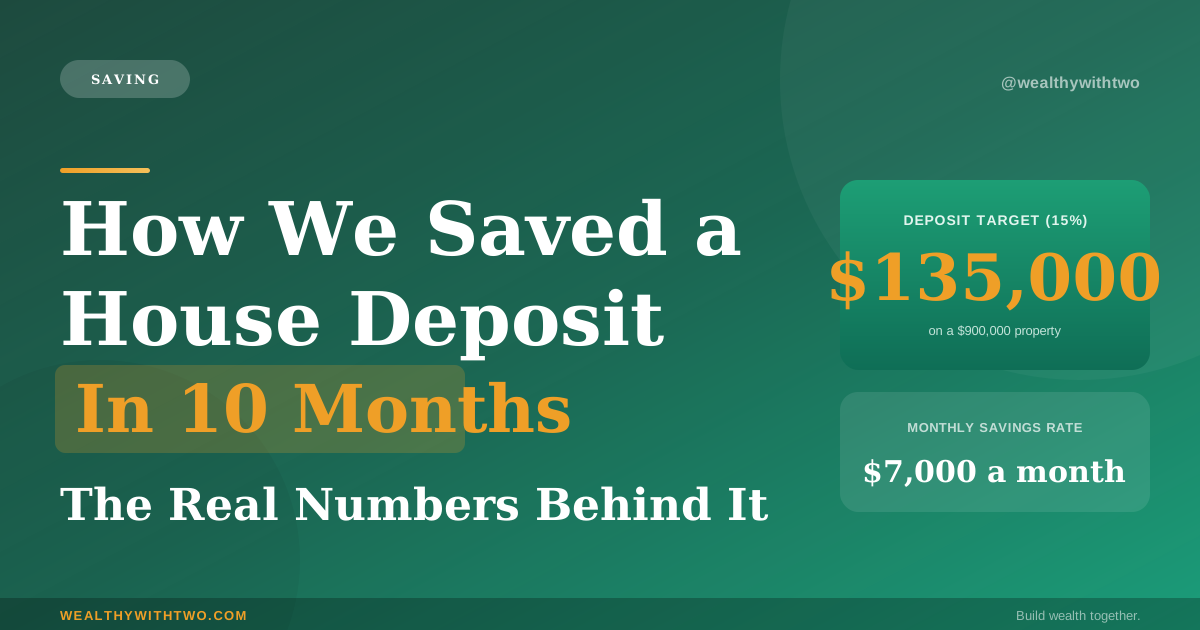
If you are earlier in the journey and still building the deposit, start with our breakdown of how we saved a house deposit in 10 months, because the cash flow work comes before any of this.
And if you want the roadmap rather than another spreadsheet: we built Kaasa to give first home buyers a proper step-by-step plan for the whole purchase journey. Deposit targets, savings timeline, and the sequence of steps between where you are now and settlement, in one place instead of a stack of tabs you stop updating.
Disclaimer: This post describes our personal experience and is for educational purposes only. It is not financial, credit, or legal advice. Contract terms, lender policies, sunset clause rules, and state stamp duty concessions vary and change, so have a licensed conveyancer or solicitor review your specific contract before signing.
Written by Mukul & Priyanka
We moved to Sydney as international students in 2019 and navigated the Australian financial system firsthand. Today, we share the exact strategies we used to build wealth, buy our first home, and achieve financial security as a migrant couple.
Read our full story →