How to Save for a House Deposit in Australia: Our 10-Month Plan to $135,000

Mukul & Priyanka
Founders, WealthyWithTwo
Most people start saving for a house deposit with a number they pulled out of thin air. We did too, and it kept us stuck for months. The problem with "we need $150,000 one day" is that it gives you nothing to act on this month. No target, no deadline, no way to tell whether the takeaway you just ordered mattered.
What actually moved us forward was working backwards. We picked a realistic property price first, converted it into a deposit figure, then checked that figure against what our cash flow could genuinely produce each month. That gave us a date. Once we had a date, every decision got easier.
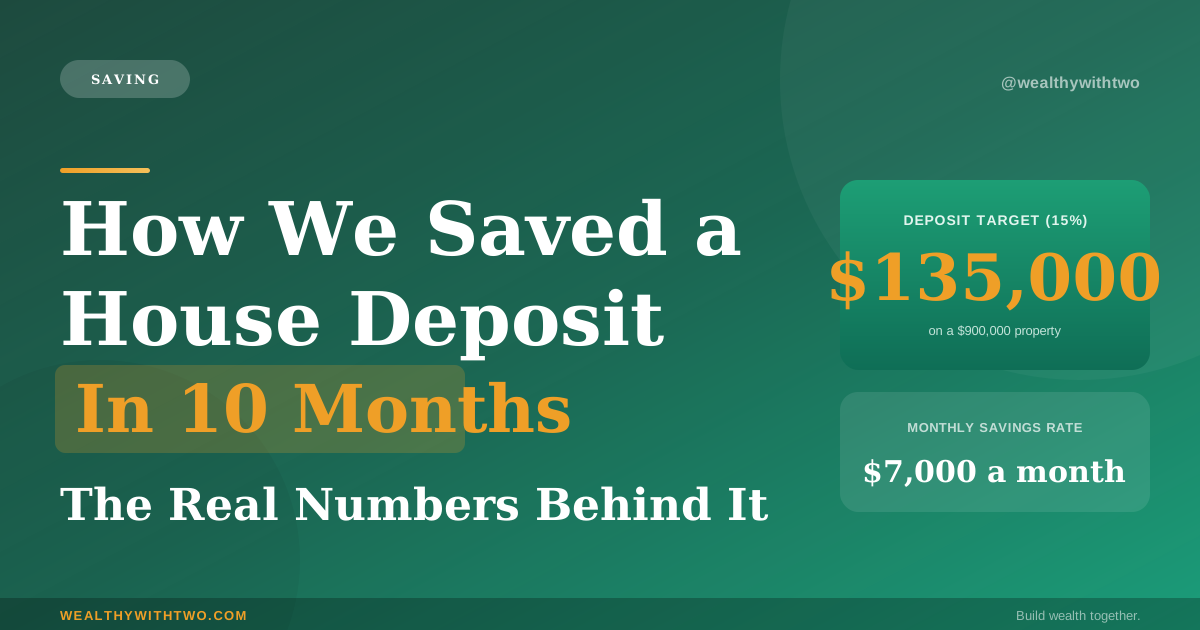
This post walks through how we saved a 15% house deposit in Australia on a $900,000 property in roughly 10 months: how we chose the price target, what we counted as deposit money, the real monthly savings rate we were working with, which expenses we cut, and which ones we deliberately refused to touch. Every number here is ours, not an example.
Key Takeaways
- Pick the property before the number. Your deposit target comes from a realistic price for a specific suburb and property type, not from a generic percentage. We set $900,000 after checking what our budget could reach.
- We started with $70,000 across savings and shares and were saving about $6,500 a month. Trimming a few subscriptions and eating out less pushed that to roughly $7,000, which turned a vague goal into a 10-month timeline.
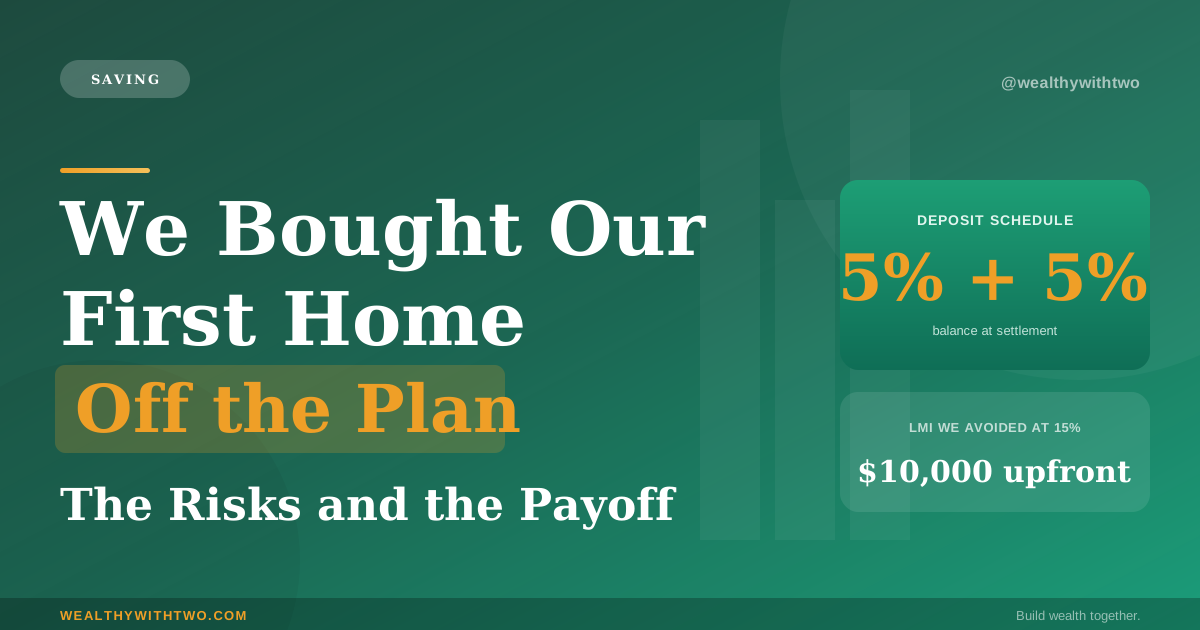
- A 15% deposit was our sweet spot, not 20%. We found a lender that waived Lenders Mortgage Insurance at 15% LVR, which saved us close to $10,000 upfront and got us in the door months earlier.
- Do not cut the spending that keeps you sane. We kept the gym, tennis, and the occasional brunch. A savings plan you resent is a savings plan you abandon in month three.
Step 1: Decide What You Are Buying Before You Decide What to Save
Before we thought seriously about saving, we had to answer some unglamorous questions: which areas did we actually want to live in, did we want a house or an apartment, how much space did we need, and what were properties like that actually selling for?
You cannot set a deposit goal without those answers, because the deposit is just a percentage of a price, and the price is set by the suburb and the property type, not by your ambition.
Location vs Property Type: The Trade-Off Nobody Escapes
We wanted a house near Bondi. So does everyone else. Once we looked honestly at what our budget could service, that combination was off the table, and pretending otherwise would have cost us a year of "saving harder" toward a number we were never going to reach.
In practice you get to pick two out of three:
- Location: how close to the city, the beach, or your workplace
- Property type and size: house vs apartment, number of bedrooms, land
- Price: what your deposit and repayments can actually support
We chose location and price, and compromised on property type by looking at apartments. Someone else in our position might keep the house and move 20 minutes further out. There is no correct answer, but there is a correct process: decide which one you are giving up before you start saving, not after.
How We Landed on a $900,000 Target
Two numbers set our ceiling:
- What we could realistically save in a reasonable timeframe, which set the deposit.
- What monthly repayment we could comfortably afford without our life collapsing if rates moved, which set the loan size.
Deposit plus borrowing capacity gave us a price band, and $900,000 was where that band overlapped with suburbs and apartment sizes we were genuinely happy with. From there the deposit maths was simple: a 15% deposit on $900,000 is $135,000.
TipRun the repayment test at a rate higher than the one you are quoted. Lenders assess you with a buffer for a reason. If the repayment only works at today's rate, the property is too expensive for you.
Working Out What You Can Actually Save Each Month
Once we had a target, the next question was how long it would take. That meant getting brutally specific about two things: what we already had, and what we were genuinely adding each month.
What Counted as Deposit Money
We went through everything: savings accounts, our shares portfolios, offset balances, and cash sitting in accounts we had half forgotten about. Total: about $70,000.
A few things worth flagging here:
- Shares are deposit money, but with an asterisk. They can fall in value right before you need them. We were comfortable holding ours because our settlement date was flexible, but if your purchase is close, think carefully about market timing.
- Money in a high-interest savings account is doing work while it waits. If your deposit is sitting in a transaction account earning nothing, you are volunteering a few thousand dollars to your bank. We wrote about choosing a high-interest savings rate separately.
- Super counts too, if you have been using the FHSS scheme. Voluntary contributions can be withdrawn for a first home deposit under the First Home Super Saver scheme. We covered how the FHSS works in detail.
Finding Our Real Monthly Savings Rate
We pulled three months of transactions and worked out what actually landed in savings each month after everything. Not what we hoped, not what the budget spreadsheet said, but the real number.
It was about $6,500 a month.
That number is the single most important input in the whole plan, and it is the one most people guess at. Your savings rate determines your timeline; your timeline determines whether the plan survives contact with reality. If you are doing this with a partner, this is also where a lot of couples discover they have very different mental models of where the money goes, something we unpacked in setting up a joint budget without fighting.
Cutting Expenses Without Making Life Miserable
With $70,000 banked and $6,500 a month going in, we were already close. The question was whether we could squeeze out a bit more without turning the next year into a punishment.
We went after the spending we would not miss and left the spending that actually made our weeks better:
| What we cut | What we kept |
|---|---|
| Streaming services we barely opened (we kept one) | Gym memberships, because health is not a line item to sacrifice |
| Eating out, reduced rather than eliminated | Tennis and hobbies that got us out of the house |
| Impulse online shopping and duplicate subscriptions | The occasional brunch, because a year is a long time |
That got us to roughly $7,000 a month.
This is the part most deposit advice gets wrong. Cutting everything looks impressive in a spreadsheet and fails in practice, usually somewhere around week six, and the blowout spend that follows costs more than the cuts saved. We deliberately protected a few things that made the grind sustainable. Saving an extra $150 a month is not worth quitting the plan over.
Our Deposit Roadmap: The Numbers That Got Us There
Here is the whole plan on one page, the version we actually worked from:
| Input | Our number |
|---|---|
| Target property price | $900,000 |
| Deposit target (15%) | $135,000 |
| Starting balance (savings + shares) | ~$70,000 |
| Savings rate before cuts | ~$6,500/month |
| Savings rate after cuts | ~$7,000/month |
| Gap to close | ~$65,000 |
| Timeline | ~10 months |
Ten months. Not "someday", but a specific, checkable date, roughly $7,000 at a time. That changed how the whole thing felt. Every month we either hit the number or we did not, and if we missed one we knew exactly what it cost us: about four days.
Why We Targeted 15% Instead of 20%
The standard advice is to save 20% to avoid Lenders Mortgage Insurance (LMI). We went with 15% on purpose.
When we shopped around, we found a lender (UBank, at the time) that did not charge LMI at a 15% deposit. The rate was slightly higher than the sharpest offers on the market, but it meant we avoided roughly $10,000 in upfront LMI. About six months in, we refinanced to a lower rate elsewhere. Net result: we kept most of the LMI saving and eventually got the better rate too.
A few things to be clear about:
- Lender policies change constantly. The specific waiver we used may not exist by the time you read this, and eligibility usually depends on your profession, income, and loan size. Treat this as a category of product to ask about, not a recommendation.
- A higher rate is a real cost. We only came out ahead because we did the maths on the interest difference over the period we expected to hold that loan, and because refinancing was realistic for us.
- There are other LMI paths. Government guarantee schemes and profession-based waivers exist. Ask a broker to lay all of them side by side before you assume 20% is the only way.
ImportantSaving an extra 5% deposit is not free either. It costs you months of rent and months of property price movement. The right deposit percentage is the one where the LMI cost, the interest cost, and the time cost balance out for your situation.
The Costs That Are Not the Deposit
The deposit is the headline number, but it is not the full amount of cash you need on hand. Budget separately for:
- Stamp duty, unless you qualify for a first home buyer concession or exemption. Thresholds and rules differ by state and change regularly, so check your state revenue office rather than trusting a blog, including this one.
- Conveyancing or solicitor fees for the contract review and settlement.
- Building and pest inspections for established properties, or a thorough contract review for off-the-plan.
- Loan application, valuation, and settlement fees.
- Moving, furniture, and the first round of things you did not know you needed.
- A buffer after settlement. Landing in your new home with zero dollars left is how a good purchase becomes a stressful year.
FAQ: Saving for a House Deposit in Australia
How much deposit do I need to buy a house in Australia?
You generally need at least 5% of the purchase price, but 20% is the level at which most lenders waive Lenders Mortgage Insurance. Below 20%, you will usually pay LMI, a one-off premium that protects the lender rather than you, unless you qualify for a waiver or a government guarantee scheme. We settled at 15% because we found a lender that waived LMI at that level.
How long does it take to save a house deposit?
Divide the gap between what you have and what you need by what you genuinely save each month. That is the honest answer, and it is usually somewhere between two and five years for a first home buyer in a capital city. We had a head start of $70,000 and a savings rate of about $7,000 a month, which is why our remaining timeline was only 10 months. Your rate matters far more than your discipline with any single expense.
Should I keep my deposit in shares or in a savings account?
Keep money you need within the next 12 to 24 months in cash, not shares. Markets can drop 20% in a quarter, and a fall at the wrong moment can push your purchase back by a year or force you to sell at a loss. We held shares as part of our deposit because our timeline was flexible; once we had a settlement date locked in, certainty mattered more than returns.
Do I need a 20% deposit to avoid LMI?
No. 20% is the common threshold, but it is not the only path. Some lenders waive LMI at lower deposits for specific professions or loan profiles, and government guarantee schemes let eligible first home buyers borrow with a smaller deposit without paying LMI. Ask a broker to compare the total cost of each option, including the interest rate difference, rather than assuming the 20% route is always cheapest.
Can I use my superannuation for a house deposit?
Yes, through the First Home Super Saver (FHSS) scheme, which lets eligible first home buyers withdraw voluntary contributions and associated earnings. It is not your entire super balance, only voluntary contributions up to the scheme caps. We wrote a full breakdown of how the FHSS scheme works, including the withdrawal steps.
Conclusion: Turn the Goal Into a Date
The thing that changed our savings from a vague intention into a purchase was not motivation. It was sequence: pick the property, derive the deposit, measure the real cash flow, then let the arithmetic tell you the date. Everything after that is just showing up each month.
If you are at the start of this, do the three-month cash flow review before anything else. You cannot plan around a savings rate you are guessing at.
We built Kaasa for exactly this part of the journey: a proper step-by-step roadmap for planning a home purchase, so you are not stitching together a fragile spreadsheet or another Notion template that you stop updating by month two. It tracks the deposit target, the timeline, and the steps between now and settlement in one place.
Next: we bought off the plan, which is a very different experience from buying an established property. Here is what buying an off-the-plan apartment is actually like, including the delay that turned out to work in our favour.
Disclaimer: This post describes our personal experience and is for educational purposes only. It is not financial, tax, credit, or legal advice. Lender policies, government schemes, and state duty rules change frequently, so verify current details and speak to a licensed professional before making decisions.
Written by Mukul & Priyanka
We moved to Sydney as international students in 2019 and navigated the Australian financial system firsthand. Today, we share the exact strategies we used to build wealth, buy our first home, and achieve financial security as a migrant couple.
Read our full story →