The FHSS Scheme: Guide to Australia's First Home Super Scheme

Mukul & Priyanka
Founders, WealthyWithTwo
Let's be completely honest: saving for a first home deposit in Australia right now feels like trying to run a marathon in quicksand. The property market moves incredibly fast, and leaving your hard-earned cash sitting in a standard bank account means inflation and income tax are constantly chipping away at your progress.
But there is a legitimate, government-backed tax hack that most people ignore simply because it sounds complex: the First Home Super Saver (FHSS) scheme.
If you want to accelerate your savings and legally slice thousands of dollars off your tax bill, here is exactly how the FHSS works, the math behind the savings, and the strict rules you have to follow to make it happen.
Be sure to check out our YouTube Channel for a visual walk-through and more personal finance breakdowns!
What is the First Home Super Saver (FHSS) Scheme?
The FHSS scheme isn't a separate bank account or a government grant. Instead, it allows you to use your existing superannuation fund as a high-powered, low-tax savings vehicle for your first home deposit.
Because super funds are taxed at a flat concessional rate of just 15% (which is significantly lower than most personal marginal income tax brackets), saving inside your super allows your money to compound and grow much faster than it would in a traditional bank account.
FHSS Contribution & Withdrawal Limits
The Australian Taxation Office (ATO) sets strict boundaries on how much you can contribute and subsequently withdraw:
- The Annual Contribution Limit: You can count up to $15,000 of voluntary contributions per financial year toward the scheme.
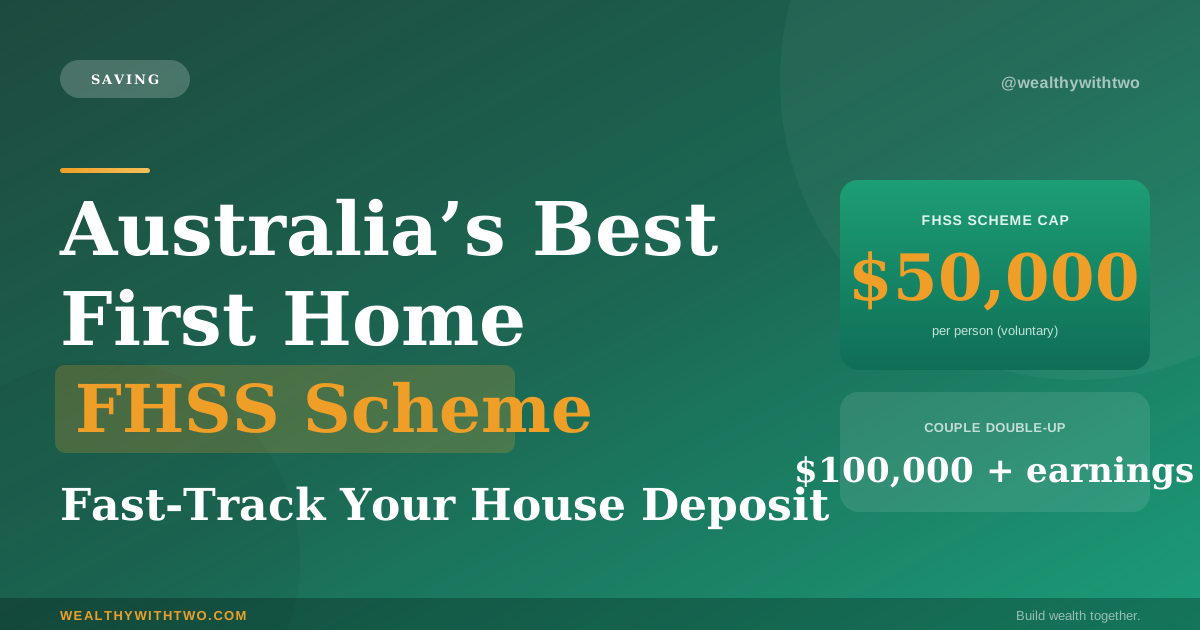
- The Lifetime Maximum Withdrawal Limit: The total maximum amount of voluntary contributions you can withdraw is $50,000 per person.
- The Power Couple Double-Up: If you are buying a home with a partner, sibling, or friend, both of you can use your own individual FHSS limits. That means a combined total of up to $100,000 plus associated earnings toward your shared deposit.
What counts as an eligible voluntary super contribution?
Only extra money you put in yourself counts. Your employer's standard Super Guarantee (SG) payments do not count toward your FHSS savings. You can make voluntary contributions in two ways:
- Concessional (Pre-tax): Money arranged through your employer via salary sacrifice, or personal cash you transfer into super and claim a tax deduction for at tax time.
- Non-concessional (After-tax): Money you transfer into super directly from your take-home pay where you do not claim a tax deduction.
TipConcessional (pre-tax) contributions are where the massive tax savings live. This is because that money avoids your higher personal income tax bracket completely, only getting taxed at the low super rate of 15% upon entry.
How Much Tax Can You Save with the FHSS Scheme?
When you salary sacrifice pre-tax money into super, it is taxed at a flat 15% instead of your individual marginal tax rate.
When it's time to withdraw your savings for your deposit, the ATO applies a withdrawal tax equal to your expected marginal income tax rate (plus Medicare) minus a generous 30% tax offset.
Here is how the numbers stack up if you contribute the maximum $15,000 in a single financial year across different income levels, comparing saving inside super versus outside super:
Tax Savings Comparison Table (2025–2027 Tax Rates)
The calculations below take into account the 2% Medicare levy and the legislated tax brackets (including the 15% rate on the lowest bracket starting 1 July 2026):
| Your Taxable Income | Personal Marginal Tax Rate (inc. 2% Medicare) | Saved Outside Super (Net Cash) | Saved Inside Super (Net after Withdrawal Tax) | Pure Tax Savings (In 1 Year) | Total Savings Over 3.5 Years (To Hit $50k Cap) |
|---|---|---|---|---|---|
| $40,000 | 17% – 18% | $12,300 | $12,750 | $300 – $450 | ~$1,050 – $1,575 |
| $90,000 | 32% | $10,200 | $12,495 | $2,295 | ~$8,032 |
| $150,000 | 39% | $9,150 | $11,602 | $2,452 | ~$8,582 |
| $200,000 | 47% | $7,950 | $10,582 | $2,632 | ~$9,212 |
*Note: Calculations assume 100% concessional contributions. They do not include the additional bonus of ATO-deemed interest earnings (calculated at the SICID rate), which means your actual withdrawal total will be even higher.
The Step-by-Step FHSS Release & Application Process
The ATO is incredibly strict about the sequence of events. If you complete steps out of order, you could lose your tax benefits or face a penalty tax.
Following the major regulatory updates (applying to all determinations), the ATO has made the timeline slightly more forgiving, but you must still follow these exact steps:
Step 1: Request an FHSS Determination (Before Settlement)
- When: Anytime before ownership of the property transfers to you (settlement).
- How: Log into your myGov account linked to the ATO, navigate to Super > Manage > First Home Saver, and apply for an FHSS Determination.
The ATO will calculate exactly how much you can withdraw based on your voluntary contributions plus associated (deemed) earnings.
ImportantCrucial Rule: You must obtain this determination before you complete your property contract (settlement). If you settle on the property before getting a determination, you cannot use the scheme. It is highly recommended to get this determination before you even sign a contract.
Step 2: Request the Release of Funds
- When: Before signing, or up to 90 days after signing a contract.
Once you have a valid determination and you are ready to purchase, submit a Release Request via myGov.
ImportantImportant Timeframe: If you sign your property purchase contract before requesting a release, you must submit your release request within 90 days of signing that contract.
The ATO will issue a release authority to your super fund, withhold the required withdrawal tax, and transfer the remaining cash to your bank account. This typically takes 15 to 25 business days (allow up to 4–6 weeks to be safe).
Step 3: Sign Your Property Contract & Move In
- When: Within 12 months of requesting your release (unless an extension is granted).
You have 12 months from the date of your release request to sign a contract to buy or build your first home. If you need more time, the ATO will automatically grant a further 12-month extension (giving you up to 24 months in total).
Living Requirement: You must intend to occupy the property as soon as practicable and live in it for at least 6 of the first 12 months after it is safe to move in.
Step 4: Notify the ATO
- When: Within 90 days of signing the contract.
Once you sign the contract to buy or build, you must notify the ATO via myGov within 90 days to confirm the purchase. (Failure to notify within 90 days can result in losing the tax benefits or paying a penalty).
What Happens If You Change Your Mind?
If you release the funds but do not end up signing a contract to buy or build a home within your designated timeframe, you have two options to avoid tax penalties:
- Recontribute the money: You can deposit the net assessable released amount back into your super fund as a non-concessional (after-tax) contribution. This keeps your funds in super until you reach retirement age.
- Pay the FHSS Tax: Keep the money for other purposes, but pay a flat 20% FHSS tax on the released assessable amount to offset the tax concessions you initially received.
Summary Checklist for First Home Buyers
- Check with your super fund to ensure they participate in the FHSS scheme (most major funds do).
- Set up regular pre-tax salary sacrifices with your payroll officer, or make manual lump-sum BPAY contributions to your super fund.
- Ensure voluntary contributions do not exceed $15,000 per financial year.
- Request an FHSS Determination on myGov before you settle on any property (ideally before you sign a contract).
- Submit your Release Request via myGov before signing or within 90 days of signing a contract.
- Notify the ATO within 90 days of signing your purchase contract.
Official Government References
For the most up-to-date legislative changes, calculators, and administrative forms, please refer directly to the official government portals:
- Australian Taxation Office (ATO): Official FHSS Scheme Guidelines
- Australian Government Housing Portal: First Home Buyers FHSS Fact Sheet
- ATO Community Forum Support: FHSS Essentials and Q&As
Written by Mukul & Priyanka
We moved to Sydney as international students in 2019 and navigated the Australian financial system firsthand. Today, we share the exact strategies we used to build wealth, buy our first home, and achieve financial security as a migrant couple.
Read our full story →